What are the 7 Steps to Map the Customer Journey?

If you’re wondering, “what are the 7 steps to map the customer journey?” you’re in the right place! While we believe in customizing journey mapping projects based on industry, product, stakeholder team needs, and other factors, there are some basic steps in how we approach developing a customer journey map.
What are customer journey maps?
Before we dive in, it’s helpful to align on a few foundational concepts:
- What are customer journeys?
- What is a user journey map?
These terms are often used interchangeably but have slightly different meanings.
A customer journey refers to the end-to-end experience a customer has with a brand across all touchpoints and channels over time. A user journey map, on the other hand, is the visual representation of that experience, typically structured to show stages, actions, emotions, and opportunities for improvement. Now…
What are the 7 steps to map the customer journey?
STEP 1: IMMERSION & RESEARCH SYNTHESIS
Get your team immersed in the customer, the products, and the competition. Make sure everyone is on the same page before you launch into the journey mapping process.
As part of this first step, review and synthesize any relevant research the company has done to date that can be used to start building a strawman of the customer journey. Leverage work you have already done.
If needed, include a handful of stakeholder interviews in this step to surface internal knowledge and assumptions.
This step is foundational because it ensures your journey mapping work starts with context rather than assumptions.
You may also find it helpful to align this phase with broader innovation and research efforts, such as those outlined in our approach to innovation strategy. 
STEP 2: ESTABLISH THE JOURNEY FRAMEWORK
Collaborate with your cross-functional team to build a framework for the journey map.
Designing the framework includes understanding what content will be most useful for the team and establishing a clear set of objectives around what the team wants the map to convey.
This includes discussions around:
- Where the journey starts and ends
- What stages or phases are included
- What components are important to call out on the map
While it’s helpful to establish a rough framework, know that it often shifts as you work with real customers.
STEP 3: INTERNAL MAPPING WORKSHOP
Conduct a workshop with the internal stakeholder team, preferably in person. This could be a half-day or full-day workshop, depending on the complexity of the journey.
Roll up your sleeves and together map a strawman journey using any company research and internal knowledge. This helps establish hypotheses to validate and test with customers.
It also uncovers where you have knowledge gaps across the journey and helps align teams around a shared starting point.
This internal version of the map is not the final answer—it is the first version of your thinking.
STEP 4: JOURNEY RESEARCH
Conduct qualitative research with customers to learn about their journey. This is the most important step since journeys are an outside-in view. The research is designed to gather insights and fill in the journey framework, but also allows for testing of the framework itself.
The research is designed to:
- Gather insights to fill in the journey framework
- Validate or challenge the internal strawman
- Reveal emotional and contextual drivers of behavior
Customize the research plan according to the journey you are creating. Journey research can consist of:
- Customer Interviews
- Customer Co-creation Summits
- Ethnographic Observations
- Digital Diaries
- And more…
There are cases where you may want to supplement with quantitative research as well.
STEP 5: DEVELOP MAP CONTENT
Using the research, create the content for the journey and fill in the framework.
At this stage, insights are synthesized into a structured view of the experience, including:
- Key journey stages
- Customer actions and touchpoints
- Pain points and friction areas
- Emotional highs and lows
- Opportunities for improvement
It’s important to create a crisp cover story for the high-level customer journey map as well as developing detailed map pages for teams who need to dig deeper.
This is where the user journey map truly takes shape, moving from raw insights into a usable strategic tool.
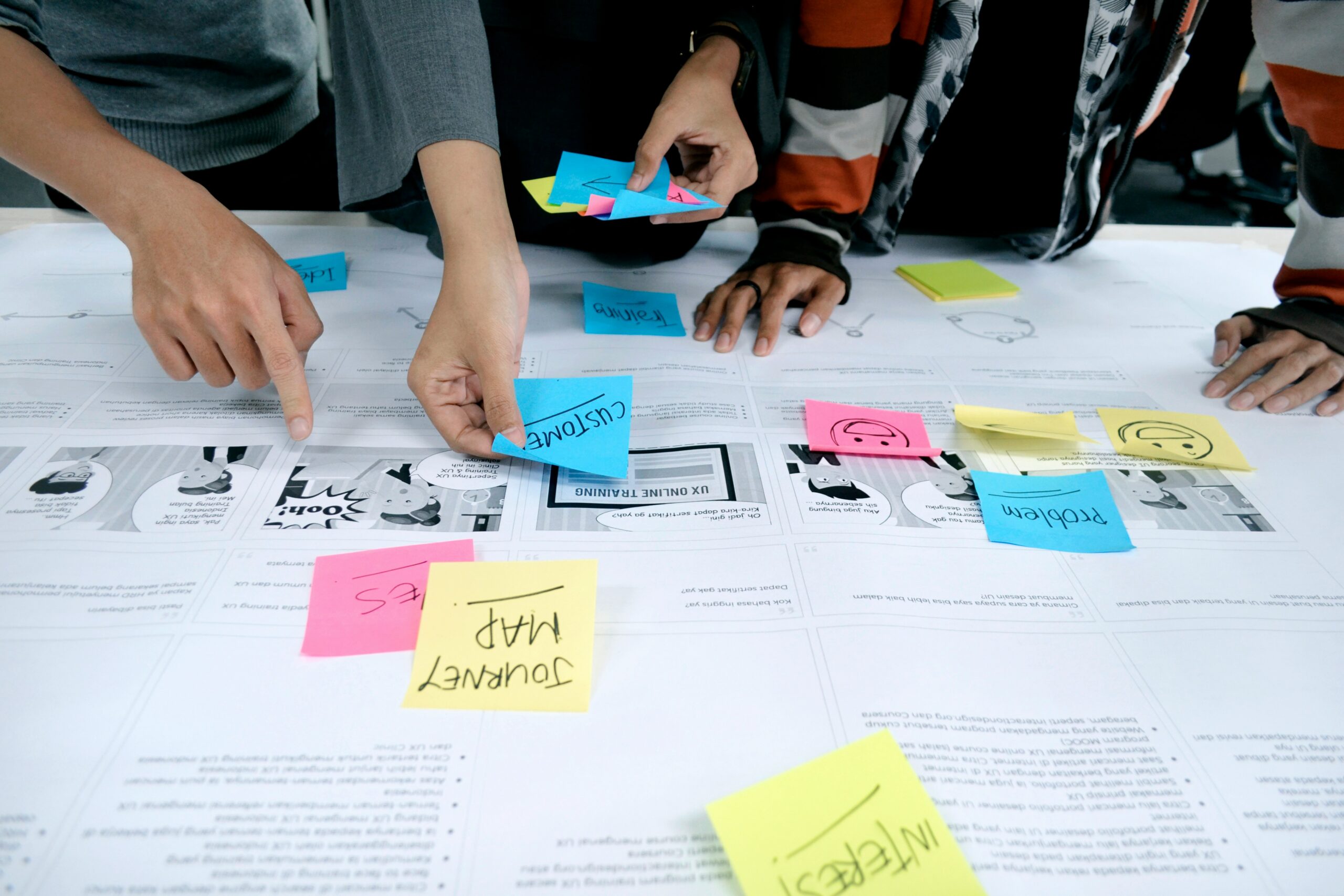
STEP 6: DESIGN THE MAP
Once you have the content, hold a design session with the team to start sketching out design direction.
The goal for design is to make it:
- Easily digestible
- Visually appealing
- Most importantly, actionable
A strong visual design ensures the journey map is not just understood but used.
STEP 7: SOCIALIZE AND ACTIVATE THE JOURNEY MAP
Once you have the map or maps, socialize them throughout the company.
This final step is often what determines whether the journey mapping effort drives real impact.
Use:
- Ideation workshops
- Action planning sessions
- Cross-functional alignment meetings
These sessions help stakeholders:
- Identify opportunities
- Ideate ways to improve the customer experience
- Prioritize a roadmap for the future
At this stage, the customer journey map becomes a living tool not a static deliverable.
What comes next?
Understanding what customer journeys are and following a structured approach to mapping them ensures teams move from assumption to alignment and from insight to action.
If you have questions or want to learn more about our journey mapping process, reach out anytime.
Contact Us